
FicoTradingHub
22+ traders now
publish their results.
Filip's trading community kept its trades in Excel sheets. I planned, designed and built a Webflow website and a trading journal in Next.js that replaced them.

Context
Filip and I met through social media. He runs FicoTradingHub: a 90-day mentorship for beginners, a VIP group, 1-on-1 coaching, and a free Discord and YouTube community.
He came with two goals: a website that gives new members the basics in one place, and a web app that brings transparency to the community he already had. There was no hard deadline, and I didn't promise one. Filip followed every step; near the end he got the finished result for one last review, and a week later, after my own final check, we went live.
Problem
The community tracked its trades in Excel sheets. A spreadsheet gives no simple overview, and it keeps every result locked in a private file. Filip wanted the opposite: a clear picture for each trader, and a place where anyone who wants to can publish their results for the whole community to see.
Process
The site
We chose Webflow together. It is a no-code platform Filip can edit himself, and its CMS leaves room for the content he plans to add. I built every page with SEO in mind from the start.
The journal
The journal is its own Next.js app, linked from the site: Webflow runs the public pages, the app handles members and their data. The architecture, the idea, the design and the plan are mine; I wrote the code with Claude Code as an assistant.
The hard part
Understanding what traders actually want to log and follow. I did thorough research into how serious traders keep their records, and that opened the door to smarter features: ones that let a trader analyse their strategy in more depth than a spreadsheet ever could.
Solution
The website
A home page with the programs and an FAQ, a ten-chapter learning section that goes from market structure to trading psychology, and a direct way into the journal.


The journal
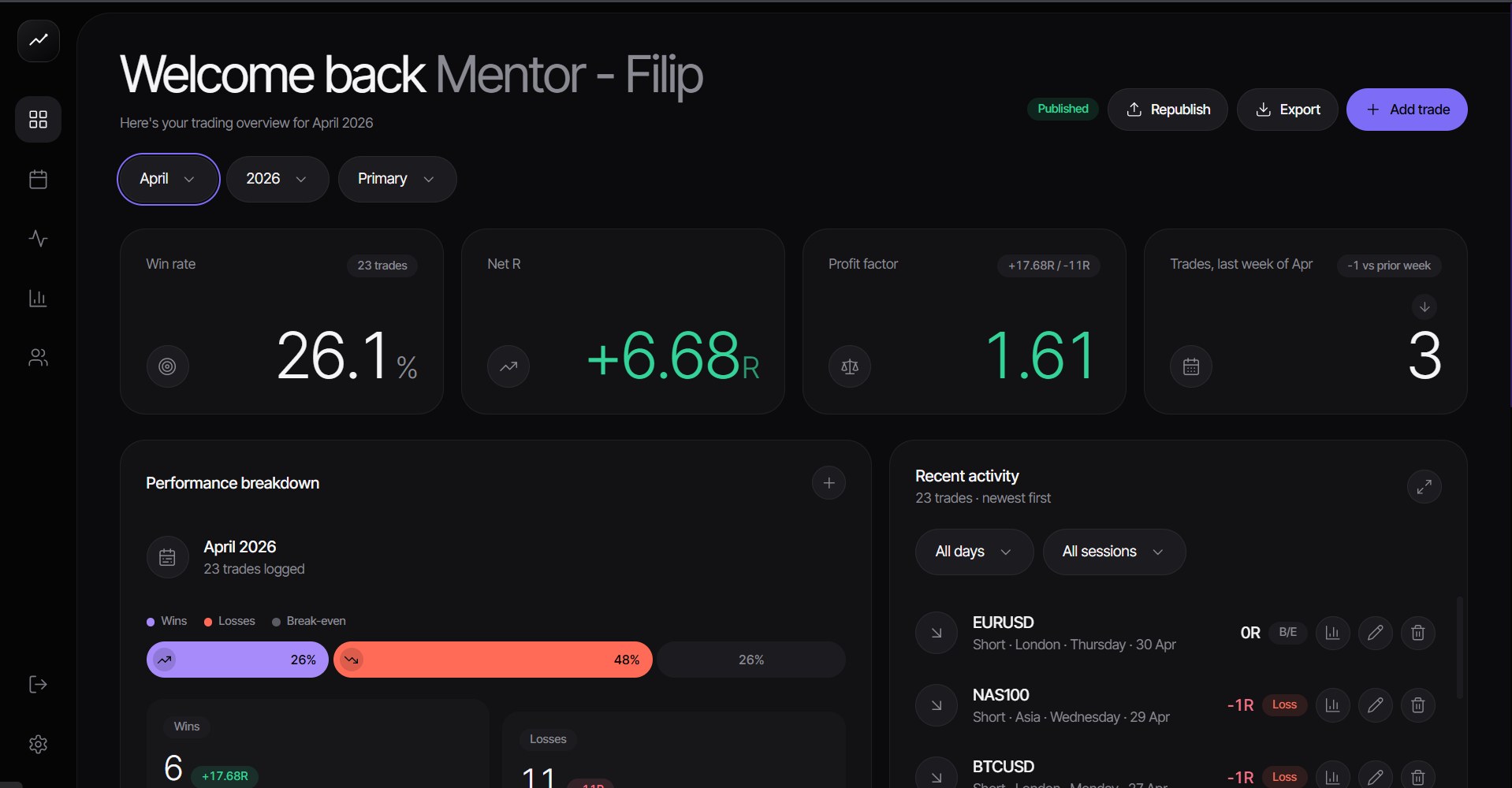
Every community has an admin who appoints mentors and gives or removes roles. Members log their trades and get a monthly dashboard: win rate, net R, profit factor, trades per week, a wins, losses and break-even breakdown, and recent trades filtered by day and trading session. Trades can be added, edited and exported, and each member decides whether to publish their results or keep them private.
Result
22+active members publish their results, and more use the journal privately
3.5months from start to launch: 2.5 of building, 1 of testing
Less hassle and more transparency than spreadsheets gave, and a site that brings steady traffic thanks to careful SEO.
Extremely professional from start to finish, communication was top-tier the whole way, and I'm genuinely happy with the end product.
 FilipFounder, FicoTradingHub
Running a community that still lives in spreadsheets?